Subscribe for Just €5 Per Month: Brussels Finance Watcher's Weekly

For €5 per month, his famous '5-minute read' briefing lands directly in your inbox — saving you hours of research, keeping you ahead of fast-moving regulatory change, and ensuring you never miss a development that matters.
Trusted by professional investors, policy professionals and financial analysts across Europe. (with Live links to all primary sources: ECB, European Commission, ESAs, BIS and more). Why they trust Graham Bishop.

(You can manage or cancel your subscription at any time via Stripe)
--------------------------------------------------------------------------------------------------
Blog from Brussels Finance Watcher's Weekly email - 22 October 2026
Doom Loops, Dead Majorities and the Deals That Actually Got Done
Banks, Bonds and the Doom Loop. The sell-off in EU government bonds swiftly rekindled familiar fears of a doom loop between banks and their sovereign hosts. Reuters offered some reassurance, reviewing the regulatory improvements since the 2009 to 2012 crisis and concluding that banks are substantially better protected. Hungary added an intriguing subplot: the new government is contemplating euro membership, though Bruegel was quick to warn that meeting the Maastricht criteria alone would be nowhere near sufficient. The criteria are the entrance exam, not the curriculum.
Deals Done, Progress Made. A genuinely productive week on the legislative front. Council and Parliament struck a deal on securitisation, including EU-level supervision of STS verifiers and eased administrative burdens. Whether it goes far enough remains to be seen. ESMA has completed the regulatory framework for T+1 settlement, now just a year away. As ESMA might put it: all that remains is simply to make it happen. ESMA also finalised its guidelines on the delay of disclosure of inside information, whilst the FSB published twelve sound practices for AI adoption. Timely, given that vast numbers of websites worldwide have been taken down as a precaution against hacking through vulnerabilities in the old PHP programming language.
Work Still to Do. FESE urged MEPs to strengthen the MISP proposals. EFAMA’s ELTIF Forum concluded that considerably more is needed to attract long-term investors at scale, and EFAMA warned that SFDR 2.0 trialogues must produce clear, investible product categories. European accountancy, audit, legal and tax associations delivered a blunt verdict on AMLA’s approach: box-ticking will not produce effective anti-money laundering controls. Fintechs such as Wise, the BIS confirmed, substantially reduce the cost of cross-border payments. Stablecoins, by contrast, lag well behind. The gap between stablecoin rhetoric and the reality remains considerable.
The Brexit Majority Has Gone. With the EU-UK Summit just a month away, the EU sounded genuinely open to deepening ties. And Kellner produced perhaps the most consequential data point of the week: the elderly Brexiteers who delivered the referendum majority have now, in sufficient numbers, died. That majority is gone permanently. The demographic arithmetic has finally caught up with the political argument.
#DoomLoop #EUSovereignBonds #BankResilience #HungaryEuro #MaastrichtCriteria #Securitisation #STSVerifiers #T1Settlement #ESMA #InsiderInformation #FSBAIpractices #PHPHacking #CyberSecurity #MISP #FESE #ELTIF #SFDR #AMLA #AMLControls #CrossBorderPayments #Wise #Stablecoins #BIS #UKEUSummit #BrexitMajority #DemographicShift #EuropeanFinance #FinancialRegulation
The archive of these blogs is here
_______________________________________________________
Is Brexit breaking Britain?
(Summarising a 27-page note with 18 Figures setting out the detailed arguments - for subscribers only)
Update: 9 July 2026: My paper pointed to the pressures on public finance due to Brexit and highlighted the plight of Hammersmoth Bridge as the epitome. Safer Highways now sets out the underlying engineering problem: Has the Death Knell Finally Sounded for Hammersmith Bridge?
The debate is no longer about whether cars will return. It is about whether Britain is prepared to save one of its most important historic bridges before engineering reality overtakes political indecision.
For more than seven years, Hammersmith Bridge has become one of Britain's most visible symbols of political paralysis.

Successive governments, Transport for London, Hammersmith & Fulham Council and neighbouring boroughs have argued over funding, responsibility and ownership. Taskforces have come and gone. Engineering reports have been commissioned. Politicians have made promises. Residents have endured years of disruption.
Now, however, a stark new reality has emerged. The London Borough of Hammersmith & Fulham's decision to effectively abandon plans to restore the bridge for motor vehicles feels less like another chapter in the saga and more like the beginning of the end....h
of Hammersmith & Fulham's decision to effectively abandon plans to restore the bridge for motor vehicles feels less like another chapter in the saga and more like the beginning of the end.
If there was ever hope that traffic would one day return to this historic crossing, it has become increasingly difficult to see how.
The economics no longer stack up
The figures alone tell the story. According to the latest report, returning Hammersmith Bridge to full vehicular use would cost around £300 million. Not to widen the bridge. Not to modernise it.
Not to create extra capacity. Simply to make a 139-year-old Victorian structure capable of carrying today's traffic safely. That staggering figure reflects a brutal engineering truth.
The bridge cannot simply be repaired.
· --- ONS Migration bulletin for year to Dec 2025: “At 171,000, long-term international net migration for year ending (YE) December 2025 has nearly halved from YE December 2024” My paper cited a study “The coming collapse in immigration to the United Kingdom” projecting a radical decline in immigration to 175,000 or less but in 2026 – so it has happened a year early! This level is well below the ONS assumption for its population projections.
Update 19 May 2026: The challenge to Prime Minister Starmer has unexpectedly lifted the lid on the long-suppressed Brexit debate. But the political class (except for the Liberal Democrats) has immediately responded by trying to nail the lid down again rather than confronting the reality. The latest research shows that the UK has already lost about £400 billion of tax revenue since 2016 (a gap now growing at about £100 billion annually). This is why voters feel Britain is broken and the recent election underlined their demand for “change”. But the political class must “level” with electors and explain that the root cause is a self-inflicted wound - Brexit. ” Emperor” Farage has never had any economic “clothes”. Without Brexit and at current tax rates, the government would soon have no need to borrow any money at all! Dramatic “change” could have been financed.
*******
Britain has obvious problems – is there a `quick fix’? Or have they been brewing for decades? Take a long run view over the 40 years from1985 – half an expected lifetime! That 40-year span included 1987’s Black Monday on Wall Street. A few years later the UK’s first “unset” from Europe arrived: Black Wednesday in 1992 when the “market vigilantes” threw the UK out of the ERM. This was the “foreign exchange” branch of the market vigilantes but the “bond market vigilantes” showed their irresistible strength during the euro crisis of 2012. UK Prime Minister Truss had an unpleasant brush with them in 2022. Even President Trump seems afraid of them, and Chancellor Reeves certainly is as they move progressively into the driving seat of UK economic policy.
Brexit has steadily pushed them into that position of power by:
1. Raising our vulnerability to an aging, and increasingly disabled, society where the non-immigrant labour force has scarcely risen in 40 years
2. curtailing economic growth due to reduced immigration
3. stalling business investment due to Brexit uncertainty - and thus productivity growth
4. inducing a cumulative shortfall of tax revenue that is nearly £400 billion since 2016 – and may double by 2030. That shortfall will require a further rise in the tax ratio – to levels last seen in 1944;
5. thereby creating a squeeze on public spending that is rending the fabric of British society – spending on the non-priority areas has fallen from 16% of GDP in 1985 to 10% today
6. fuelling the deep concerns of the holders of Britain’s government debt – effectively giving “all the cards” to the bond market vigilantes
7. creating political instability due to the manifest contradiction between large majorities who think Brexit was a mistake and the opinion polls showing that Reform will be the largest party after the 2029 General Election.
This lengthening list of the consequences of Brexit has created a serious and growing risk of a debt crisis. Extraordinarily - and unaware of the inexorable logic of this chain of events – electors presently seem likely to elevate one of the original (and leading) architects of this disaster to be Prime Minister, despite their historic repudiation at the last General Election of the political party that actually “Got Brexit done”.
Would re-joining the EU and joining the euro be an answer to our economic problems? The biggest political problem may be to convince the EU that we are serious about re-joining as they can read the opinion polls. What are the chances of Prime Minister Farage willingly leading the charge to re-join the EU and then join the euro??? Will the foreign bond market vigilantes leave him no option but to take the “road to Damascus” on this matter?
(Previous blogs are archived here)
======================================================================
(Graham Bishop was a member of this Group, and an author)
ELEC position paper: Why EU Capital Markets Union has become a “must have” and how to get there – ELEC Group of Wise Persons
Its report highlighted the need for CMU - with five concrete proposals for action by EU policymakers on insolvency proceedings, securitisation, stimulating retail investment, expand ESMA's powers, check feasibility of a globally significant `safe asset'.
Executive Summary
Five proposals for policymakers
1. Harmonise the key elements of corporate insolvency proceedings and consider adopting an opt-in regime based on international standards, perhaps by “enhanced co-operation” among a willing group of Member States
2. Create the conditions for securitisations to become a complement to bank finance
3. Stimulate retail investment via an array of actions including tax incentives and more auto-enrolment in pension funds
4. Empower ESMA to become the supervisor of wholesale capital markets via joint supervisory teams with national competent authority (NCA) staff
5. Investigate the feasibility of developing the ultimate High Quality Liquid Asset for financial institutions – a “safe asset” in the form of a Eurobill fund
Five reasons why CMU has moved from being `nice to have’ to `must have’:
1. Europe’s green and digital ambitions require more private capital and a more efficient deployment of the existing stock
2. Efficient financial markets with modest asset management fees can produce and protect wealth for ageing populations
3. Mature capital markets provide cheaper and more diversified sources of funding, spurring innovation and economic growth
4. Developed capital markets promote Europe’s strategic autonomy
5. Deep and integrated capital markets strengthen financial stability by facilitating risk-sharing, reducing the strong reliance on bank finance and pricing risks efficiently
more at ELEC-LECE
European League for Economic Co-operation
(ELEC is a network of European entrepreneurs of goodwill, aimed at putting timely intellectual pressure on European decision makers to further economic integration in Europe. It acts in complete independence from national or private interests, public authorities or any pressure groups.)
_____________________________________________________________________________________________
Graham Bishop has drawn together a collection of his earlier works on the possible role of “market discipline” in ensuring financial stability in the Economic and Monetary Union (EMU). The first paper was published by Salomon Brothers in 1989 during the Maastricht Treaty negotiations and the final paper in the series was published in 1993. They established Graham Bishop's reputation as a thinker about the practical mechanics of the single currency - set within the political choices about financial market regulation.
His central point was that public debts denominated in a currency that a government could not order to be “printed” – the euro – had a fundamentally different credit quality than paper money that could be printed at will – in extremis. That different quality should be reflected properly in the then-newly developed system of risk weightings for banks holding public debt as a core asset. This argument was seen as an `inconvenient truth’ at the time.
Three decades on, Italy’s blocking of revision to the ESM Treaty and Germany’s unwillingness to complete the European Deposit Insurance Scheme (EDIS) illustrate that risks to financial stability remain significant – if merely latent.
******
==============================================
My recent papers on the City of London after Brexit have stirred great interest - with several videos.
____________________________________________________________________________________________
I have recorded a video with the Federal Trust's Brendan Donnelly to set out my views about the prospects of a Brexit reset for the City of London. Sadly, I believe hopes of a major improvement are doomed as the plans will inevitably founder on the rock of derivatives clearing.
The UK has never publicly shown any sign of recognising the EU’s concerns about its financial stability flowing from potential problems in the derivatives markets but the EU has kept on legislating to resolve potential problems. Most recently the “Active Account Requirement” (AAR) was enacted and becomes operational in a matter of days.
That will probably be too late to retain the current June 30th ending of the EU’s equivalence decision for UK CCPs. So it may have to be rolled over for say another 18-24 months. Accordingly, any further renewal will be overshadowed by the possible consequences of the UK’s 2029 General Election and the possibility of a Brexit-favouring government.
As always, I am delighted to receive any feedback at graham@grahambishop.com
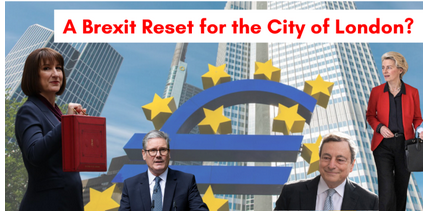
A Brexit Reset for the City of London?
My rough speaking notes for the video are here and my detailed 2022 evidence to a House of Lords enquiry is here.
Three years after leaving the EU, there are no discernible signs of any benefits for UK finance. There are multiplying signs of a lack of substance to the initial, bold slogans. I polled the audience on whether the UK will become a `rule-taker' for green and digital finance? I was very surprised at the strength of the audience response: 84% agreed strongly/somewhat and only 11% disagreed somewhat!
_____________________________________________________________________________________
In this latest Federal Trust video, Graham Bishop describes the growing risks to the City of London from Brexit. He contrasts the methodical approach of the European Union to building its Capital and Banking Union with the confused rhetoric of the British government. He concludes by warning that a smaller City of London will be able to contribute less to the already stretched public finances of the UK.
SPEAKERS:
Brendan Donnelly is the Director of the Federal Trust and a former Conservative MEP. Graham Bishop is a member of the Federal Trust and an analyst and commentator on economic affairs.
_____________________________________________________________________________________________
He has drawn together a collection of his earlier works on the possible role of “market discipline” in ensuring financial stability in the Economic and Monetary Union (EMU). The first paper was published by Salomon Brothers in 1989 during the Maastricht Treaty negotiations and the final paper in the series was published in 1993. They established Graham Bishop's reputation as a thinker about the practical mechanics of the single currency - set within the political choices about financial market regulation.
His central point was that public debts denominated in a currency that a government could not order to be “printed” – the euro – had a fundamentally different credit quality than paper money that could be printed at will – in extremis. That different quality should be reflected properly in the then-newly developed system of risk weightings for banks holding public debt as a core asset. This argument was seen as an `inconvenient truth’ at the time.
Three decades on, Italy’s blocking of revision to the ESM Treaty and Germany’s unwillingness to complete the European Deposit Insurance Scheme (EDIS) illustrate that risks to financial stability remain significant – if merely latent. _________________________________________________________________________________________
Federal Trust VIDEO with Bishop and Stevens: Brexit is Crippling the City of London
In this video, our Council member, financial expert Graham Bishop, reviews the prospects for the City of London after Brexit. He argues that the British government’s “Edinburgh reforms”, designed to help the City, are little more than pro-Brexit propaganda. They will usually make little difference and in some cases risk repeating the mistakes which led to the financial crisis of 2007-2009
__________________________________________________________________________________________
Studio Europa Maastricht: Looking back at ‘Euro at 20: shifting paradigms?’ - Graham Bishop's contribution
Studio Europa Maastricht organised the conference Euro at 20: shifting paradigms? to commemorate the 20-year anniversary of the euro and the EMU. In this blogpost we will share all photos, videos and transcripts of the day with you.
About Euro at 20
At Euro at 20 economists, politicians, journalists and central bankers engaged in dynamic discussions with each other and the many attendees. The conference consisted of keynote lectures and various sessions on topics about the euro and the Economic and Monetary Union (EMU).
Takeaways
The general consensus of the experts was that the euro and the EMU structure it was built on have come a long way in the last 30 years. However, there were also critical voices that stated there are still challenges to overcome. Notably, the proposed solution to these challenges can be summarised in one word: solidarity. Be it through fiscal transfers, EU recovery funds or Eurobonds, solidarity is imperative for protecting and sustaining the EMU’s unique yet fragile equilibrium.
It was inspiring to hear the constructive visions the diverse group of attendees had on the euro’s future. The Q&A sessions that followed the panels allowed for lively debate between experts and the audience on the actions needed to reach this envisioned future. What everyone could agree on, however, was that the currency policymakers had in mind when signing the Maastricht Treaty, is one worth working for.
Studio Europa Maastricht
__________________________________________________________________________________________________
Financial Services Club/ZYen video with Alderman Mainelli and Graham Bishop: Brexit: Ending the City's Dominance of European Finance?
Among other implications, the loss of its status as the main Euro clearing centre might also put in jeopardy its role as the leading global US Dollar hub.
__________________________________________________________________________
GrahamBishop.com analysis targets the interaction of the driving forces of politics and economics as they force the required changes in financial regulation – at the macro level rather than covering the micro aspects of detailed implementation. These are precisely the topics where a well-informed financial professional should remain competent – as part of their Continuing Professional Development (CPD).